

On December 18, the main structure of the first building (Administrative, Teaching, Research, and Training Complex) of Peking University People's Hospital Xiong'an Campus, designed by IPPR, was successfully topped out, marking a new stage in the project's development. Xu Haitao, General Manager of IPPR, attended the topping-out ceremony.
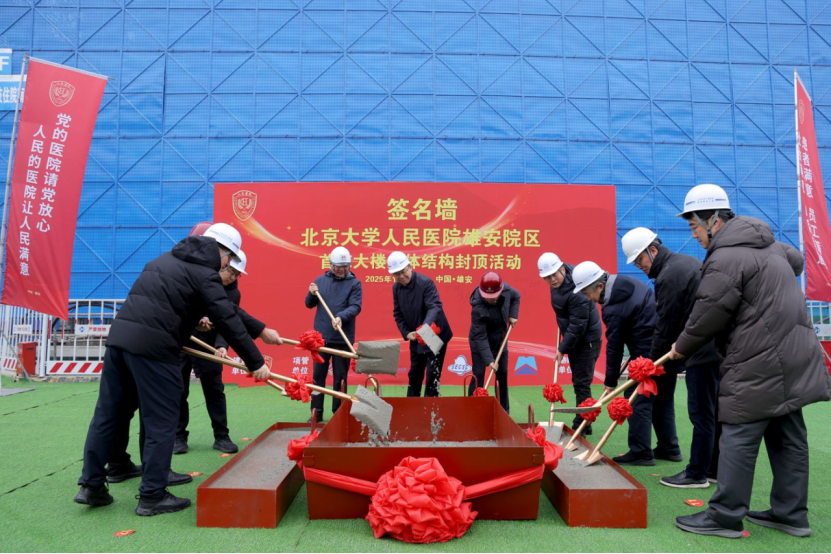
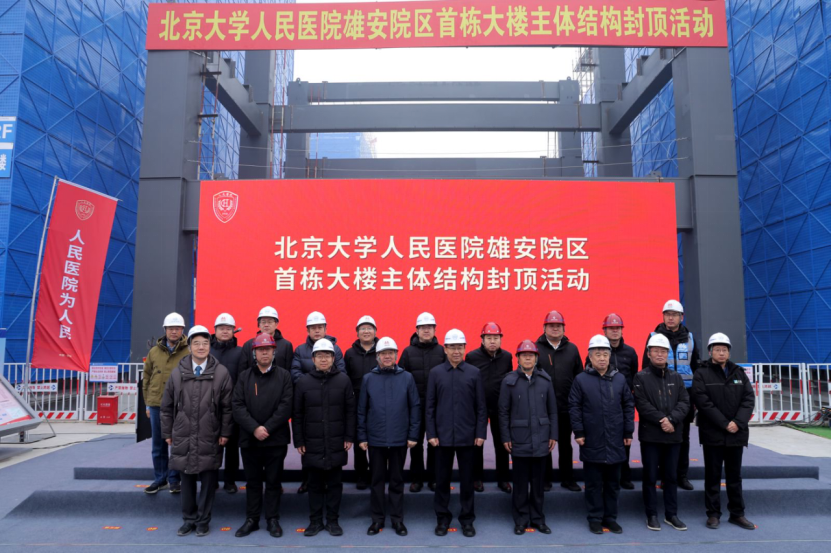
Nestled in the Rongdong Area of Xiong'an New Area, the project covers around 76,407 m2 of land, with a total building area of 255,700 m2 and a planned capacity of 1,000 beds. Upon completion, it will serve as a key hub for coordinated healthcare development in the Beijing-Tianjin-Hebei region, delivering higher-quality, more accessible, and more efficient medical care to patients within the region and throughout China.
Design Empowerment: Building a Benchmark Grade A Tertiary Hospital
Precise Alignment with the New Area's Positioning and Hospital Functions
The architectural design is closely aligned with the development requirements of Xiong'an New Area, focusing on the diverse needs of diagnosis and treatment, scientific research, and teaching of a Grade A tertiary hospital. It scientifically plans the spatial layout and medical circulation routes, balancing diagnosis and treatment efficiency with patient experience.
Green Principles Embedded Throughout the Design
Guided by Xiong'an New Area's green development plan, the building integrates low-carbon and energy-saving design concepts, laying a solid foundation for a green and smart hospital.
Innovative Structural Technologies for Efficient Construction
The administrative, teaching, research, and training complex adopts a structural system combining a steel frame with energy-dissipating buckling-restrained braces (BRB), along with a composite floor system of reinforced steel truss concrete slabs. This system offers excellent seismic performance, a high degree of prefabrication, rapid construction speed, and strong energy-saving and environmental benefits.
The construction of Peking University People's Hospital Xiong'an Campus is more than just an effort to optimize Beijing's medical layout and relieve non-capital functions. It also represents a key initiative to balance the distribution of high-quality medical resources and advance the Healthy China Initiative. Upon completion, the project will serve as a critical hub for coordinated healthcare development in the Beijing-Tianjin-Hebei region, delivering higher-quality, more accessible, and more efficient medical care to people within the region and throughout China.